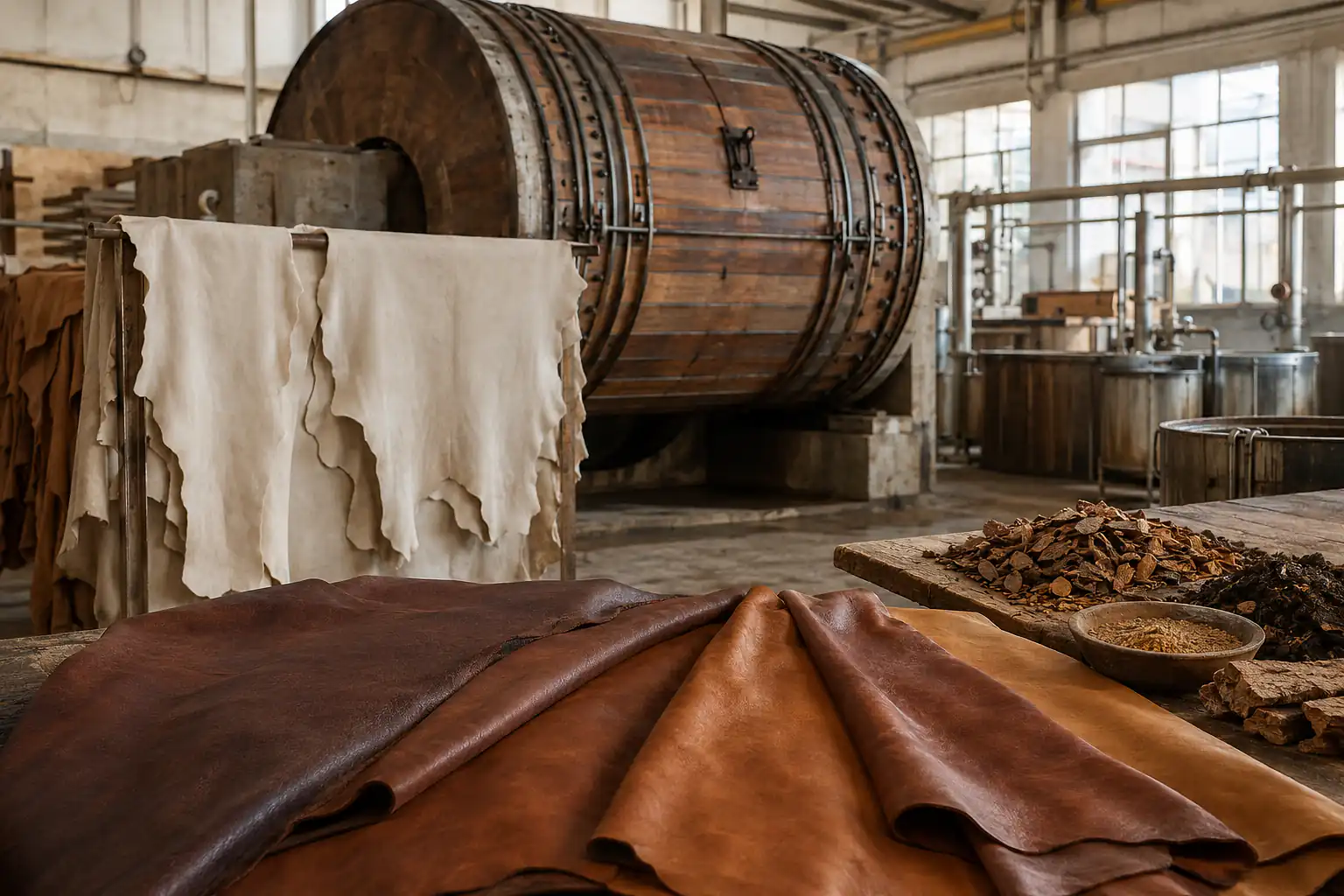
Leather has been used for thousands of years to make footwear, bags, clothing, furniture, saddles, protective equipment and everyday accessories. However, an animal hide does not naturally become leather. Without proper treatment, raw hide contains moisture, fats and proteins that allow it to deteriorate rapidly.
Tanning is the process that transforms a perishable hide or skin into stable, durable and usable leather. It preserves the collagen structure within the hide and helps the finished material resist decomposition, heat, moisture and physical wear.
Different tanning methods produce leather with very different characteristics. Some methods create firm, structured leather suitable for belts and saddles, while others produce soft, flexible leather for handbags, jackets, gloves and upholstery. Understanding how leather is tanned helps explain why two genuine leather products can look, feel, age and perform very differently.
What Does Leather Tanning Do?
Animal hides are primarily composed of water, collagen, fats and other proteins. Collagen is the fibrous protein that gives skin its natural strength and structure.
In an untreated hide, collagen is vulnerable to bacteria, moisture and temperature changes. Tanning agents form stable bonds with the collagen fibres, preventing them from breaking down and allowing the hide to retain its flexibility.
The term “tanning” originally referred to the use of natural tannins obtained from tree bark, leaves, wood and fruit. Today, leather may be tanned using vegetable extracts, chromium salts, aldehydes, synthetic tanning agents, oils or combinations of several substances.
Tanning is only one part of leather production. The complete process normally includes preparing the hide, tanning it, dyeing and conditioning it, drying it and applying the required surface finish.
How Are Hides Prepared for Tanning?
Before tanning begins, hides must be cleaned and prepared. Fresh hides are commonly preserved with salt or controlled drying so they do not deteriorate while being transported to a tannery.
Soaking
The hide is soaked in water to remove salt, blood, dirt and other contaminants. Soaking also restores some of the moisture lost during preservation.
Liming
The hide is treated in an alkaline solution. Liming loosens the hair, removes unwanted proteins and opens the collagen structure so tanning agents can penetrate effectively.
Fleshing and Splitting
Mechanical equipment removes remaining fat, flesh and tissue from the underside. A thick hide may then be divided horizontally into layers. The upper section contains the natural grain and is called the grain split. Lower layers are known as flesh or middle splits. Split leather is still genuine leather, although it does not have the same natural grain surface as the upper layer.
Deliming, Bating and Pickling
The alkalinity created during liming is reduced. Enzymes may be used to remove unwanted proteins and soften the hide. For many tanning systems, the prepared hide is then treated with acid and salt to lower its pH. This stage, called pickling, helps tanning agents penetrate the collagen fibres evenly.
1. Vegetable Tanning
Vegetable tanning is one of the oldest established tanning methods. It uses naturally occurring tannins extracted from plant materials such as mimosa, chestnut, quebracho, oak and other types of bark, wood, leaves and fruit.
Traditionally, hides were suspended in pits containing progressively stronger tanning solutions. The complete process could take several months. Modern vegetable tanning commonly uses rotating drums and carefully controlled concentrations, reducing production time to several weeks or, in some systems, even less.
Vegetable-tanned leather is generally firm, substantial and structured. In its undyed state, it commonly has beige, tan or warm brown tones, although it can be dyed in many colours.
One of its most appreciated characteristics is its ability to develop a patina. Sunlight, handling, natural oils and daily use gradually change the leather’s colour and surface. Over time, a quality vegetable-tanned product can become darker, smoother and more individual.
Vegetable-tanned leather is commonly used for:
- Belts, wallets and watch straps
- Saddles and harnesses
- Structured bags and briefcases
- Knife sheaths and footwear components
- Hand-tooled and handcrafted leather goods
Leatherworkers value it because it can be carved, stamped, moulded and burnished. However, it is often firmer than chrome-tanned leather and may need time to soften. It can also be sensitive to water. Heavy saturation or incorrect drying may cause staining, stiffness, shrinkage or changes in shape.
Although it uses plant-derived tannins, vegetable tanning is not automatically impact-free. Water consumption, energy use, transport and wastewater treatment all influence its environmental performance.

2. Chrome Tanning
Chrome tanning is the most commonly used tanning method worldwide. It generally uses chromium(III) salts, particularly basic chromium sulphate.
The method became commercially important during the nineteenth century because it was much faster than traditional vegetable tanning. The primary chrome-tanning process can often be completed within approximately one day.
Chrome-tanned leather is usually softer, lighter and more flexible than vegetable-tanned leather. It also offers good resistance to heat and moisture and can be produced in a wide range of colours. Its strong affinity for dyes makes it particularly suitable for bright, consistent fashion shades.
It is frequently used for handbags, shoes, boots, leather jackets, gloves, furniture upholstery, automotive interiors and other products that require flexibility.
After tanning, chrome-tanned leather has a characteristic pale blue-grey colour and is commonly called wet-blue leather. Wet-blue is an intermediate material that still requires retanning, dyeing, conditioning, drying and finishing.
The chromium used for tanning is chromium(III), which is different from the more hazardous chromium(VI). Nevertheless, poor process control, unsuitable chemical handling or improper disposal can still create environmental and safety problems.
Responsible tanneries carefully manage temperature, pH, chemical quantities, wastewater and waste disposal. Modern facilities may also recover and reuse chromium from tanning baths. Chrome tanning should therefore be assessed by both the tanning chemistry and the tannery’s environmental controls.

3. Chrome-Free and Metal-Free Tanning
“Chrome-free” and “metal-free” are sometimes used interchangeably, but they do not mean the same thing.
Chrome-free leather is made without chromium-based tanning agents. It may still be tanned using other mineral compounds containing aluminium, zirconium or titanium. Metal-free leather, by comparison, is produced without tanning metals or must meet strict limits for their presence. It may instead use aldehydes, synthetic agents or other organic tanning systems.
This distinction matters because leather described as chrome-free is not necessarily free from all metal-based tanning agents.
Chrome-free leather is often promoted as a more environmentally conscious choice. However, removing chromium does not automatically make a tanning system sustainable. Alternative tanning chemicals also require energy, water, responsible handling and effective wastewater treatment. The complete manufacturing process must be considered.

4. Aldehyde Tanning and Wet-White Leather
Aldehyde tanning uses reactive organic compounds to stabilise collagen. Modern systems may use glutaraldehyde, modified aldehydes or related chemistry rather than chromium salts.
Aldehyde-tanned leather is often pale cream or white before dyeing. It can form part of what the leather industry calls wet-white.
Wet-white is not one exclusive tanning method. According to the Leather Working Group’s industry definitions, wet-white leather may be produced using substances such as zirconium salts, aluminium salts, modified aldehydes, glutaraldehydes and syntans that create a whitish intermediate material.
Aldehyde-tanned leather can be soft and lightweight and may be suitable for pale or vivid colours. Depending on its formulation, it is used for baby footwear, gloves, garments, automotive upholstery and products requiring chrome-free specifications.
Some chrome-free products are promoted as hypoallergenic. This claim should be treated carefully unless supported by appropriate testing. Chrome-free does not automatically guarantee that a finished product will suit every person with sensitive skin.

5. Synthetic Tanning
Synthetic tanning agents, commonly called syntans, are manufactured compounds designed to imitate or supplement some of the tanning properties of natural tannins.
Syntans include a wide range of formulations. Some may serve as primary tanning agents, although many are used during retanning after an initial chrome, vegetable or alternative tanning process.
Synthetic tanning agents can help:
- Lighten the colour of leather
- Improve softness and fullness
- Assist dye penetration and colour consistency
- Modify the appearance of the grain
- Control flexibility and texture
Syntans allow tanneries to tailor leather to its intended use. Glove leather, for example, requires different softness and stretch from leather used for belts or structured briefcases.
Synthetic-tanned leather should not be confused with synthetic leather. Synthetic-tanned leather is still made from animal hide; “synthetic” refers to the tanning agent rather than the base material.

6. Combination Tanning
Many modern leathers are produced through combination tanning rather than one tanning method alone.
A hide may first be chrome-tanned and then retanned with vegetable tannins, syntans, resins, oils or other substances. Alternatively, it may initially be vegetable-tanned and subsequently retanned with chromium salts. Leather first vegetable-tanned and then retanned with chromium salts is specifically known as semi-chrome leather.
Combination tanning allows manufacturers to balance different qualities. It can combine the softness, flexibility and heat resistance associated with chrome tanning with the body, natural feel and ageing characteristics associated with vegetable tanning.
This approach is common in quality bags, boots, shoes, belts, saddlery, upholstery and outdoor products. The final result depends on the sequence of treatments, chemicals selected and quantities applied. Consequently, a simple label such as “chrome-tanned” may not reveal the leather’s complete production history.

7. Oil Tanning
Oil tanning uses oxidisable oils and fatty substances to help stabilise and soften a hide.
One of the best-known examples is chamois leather, traditionally produced using fish or marine oils. During processing, the oils penetrate the hide and undergo controlled oxidation, creating soft, flexible and highly absorbent leather.
Chamois has traditionally been used for cleaning, polishing, drying delicate surfaces, gloves and specialist garments.
Some commercial products are described as oil-tanned even when their primary tanning method involves chrome or combination tanning. These leathers may instead receive substantial applications of oils and waxes during retanning and finishing.
Oil-rich leather often has a deep colour, rugged appearance and slightly waxy feel. It may show lighter areas when bent or scratched because the oils and waxes move within its structure. This character makes it popular for work boots, outdoor footwear, rugged bags, equestrian products and gloves.

8. Brain Tanning
Brain tanning is a traditional method that uses emulsified fats, historically obtained from animal brain tissue, to soften and preserve hides.
After the fats are worked thoroughly into the hide, the material may be stretched repeatedly as it dries. It is often smoked to improve stability and help it retain softness after becoming wet.
Brain-tanned leather is exceptionally soft, flexible and breathable. It has traditionally been used for buckskin, moccasins, garments, pouches and cultural objects.
The method has been practised by different Indigenous cultures and reflects generations of specialised knowledge about animal materials and locally available resources. It is labour-intensive and is rarely used in large-scale leather manufacturing.
Brain tanning should be treated separately from oil tanning. Although both processes use fatty substances, their techniques, traditions and finished characteristics are not identical.

9. Alum Tanning or Tawing
Alum tanning, more accurately known as tawing, uses aluminium salts, often combined with salt, flour, egg yolk or other substances.
It is one of the oldest methods used to treat hides and produces soft, pale or white material. Historically, alum-tawed material was used for gloves, bookbinding, decorative leather and specialist goods.
Tawing is not always considered true tanning because traditional alum treatments may not form permanently water-resistant bonds with the hide. Repeated washing or heavy soaking can remove some of the treatment and cause the material to lose stability.
Modern mineral systems using aluminium may combine it with other agents to improve performance. Because aluminium is a metal, aluminium-tanned leather can be chrome-free but should not be described as metal-free.

10. Formaldehyde Tanning
Formaldehyde was historically used as an aldehyde tanning agent for certain speciality applications. It can stabilise collagen and produce pale leather with resistance to heat and washing.
It is now less commonly used as a primary tanning agent because of health, safety and regulatory concerns. Modern manufacturers may use alternative aldehyde-based compounds or modified systems designed to achieve similar properties with better control.
Formaldehyde tanning should not be used as a general name for every form of aldehyde tanning. Glutaraldehyde, modified aldehydes and oxazolidine-based systems have different chemical structures and performance characteristics.
Finished leather may also contain trace formaldehyde originating from dyes, resins or finishing chemicals even when it was not the primary tanning agent. Reputable manufacturers test finished products against applicable restricted-substance requirements.

Retanning, Dyeing and Fatliquoring
Primary tanning preserves the hide, but it does not create the finished leather by itself. Leather normally undergoes several additional treatments.
Retanning modifies firmness, softness, fullness, flexibility and water resistance. Vegetable tannins, chromium salts, syntans, resins, aldehydes and other agents may be used during this stage.
Dyeing introduces colour. Drum dyeing allows colour to penetrate deeply, while pigments and surface coatings may later create a more uniform appearance.
Fatliquoring introduces carefully selected oils and fats. These lubricate the collagen fibres so they can move without sticking together. Without sufficient lubrication, leather may become stiff and vulnerable to cracking.
The leather is then dried and may be mechanically softened through staking, milling or tumbling.
How Finishing Changes Leather
The appearance of finished leather depends heavily on what happens after tanning.
Full-grain leather retains its complete natural grain surface. Top-grain leather has generally received some surface correction, while corrected-grain leather is buffed more extensively and may be embossed with a new grain pattern.
Aniline leather is coloured with transparent dyes that allow natural variations to remain visible. Semi-aniline leather has a light protective coating, providing greater stain resistance while preserving much of the natural appearance. Pigmented leather receives a more substantial coloured coating, creating consistency and improved protection.
Nubuck is produced by lightly sanding the grain side, while suede is usually created from the flesh side or a split layer. Patent leather has a highly glossy coating. Pull-up leather contains oils and waxes that move when the surface is bent, creating temporary variations in colour.
These terms describe the surface, appearance or finishing process—not necessarily the tanning method. Chrome-tanned leather, for example, may be finished as aniline, pigmented, nubuck or pull-up leather.
Which Leather Tanning Method Is Best?
There is no single tanning method that is best for every product.
Vegetable-tanned leather is well suited to belts, structured bags, saddlery and handcrafted goods expected to develop a distinctive patina. Chrome-tanned leather is often ideal for soft bags, jackets, gloves, upholstery and footwear requiring flexibility and colour consistency.
Chrome-free, aldehyde or synthetic systems may be selected when a manufacturer needs pale colours, particular performance characteristics or compliance with chrome-free requirements. Oil-rich and combination-tanned leathers work well for boots, bags and outdoor products requiring softness, durability and a rugged appearance.
Quality depends on more than the tanning agent. The condition of the original hide, tannery expertise, chemical controls, retanning, dyeing, finishing and product construction all influence the result. Poorly produced vegetable-tanned leather is not automatically superior to responsibly produced chrome-tanned leather.
Environmental Responsibility in Leather Tanning
Every commercial tanning method has an environmental footprint. Leather production uses water, energy and chemicals and creates wastewater and solid waste that must be managed responsibly.
A modern tannery can reduce its impact through:
- Effective wastewater treatment
- Chromium recovery and recycling
- Reduced-water processing
- Responsible chemical selection and storage
- Proper treatment or reuse of solid waste
- Energy-efficient equipment
- Worker health and safety controls
- Raw-material traceability
- Independent environmental auditing
Consumers should be cautious of vague descriptions such as “eco leather,” “natural leather” or “chemical-free leather.” Every genuine tanning process involves chemistry, including traditional vegetable tanning.
More meaningful indicators include traceability, durability, transparent manufacturing, restricted-substance testing and sourcing from independently audited manufacturers. The Leather Working Group provides an auditing and certification framework for assessing leather manufacturers.
Leather is generally produced from hides generated by the meat industry. Turning these hides into durable products can prevent a substantial biological material from being discarded. However, this does not remove the need for responsible animal sourcing and environmentally controlled processing.
Final Thoughts
Leather tanning combines science, craftsmanship and centuries of accumulated knowledge. It transforms a material that would otherwise decompose into leather capable of remaining useful for many years.
Vegetable tanning creates firm leather known for its natural character and evolving patina. Chrome tanning produces soft, versatile leather used throughout modern footwear, fashion and furniture. Chrome-free mineral, aldehyde and synthetic processes provide alternatives for specialised requirements, while combination tanning allows manufacturers to balance several desirable properties.
Traditional brain, oil and alum processes also remain important parts of leather’s history and continue to be used in selected craft and speciality applications.
The name of the tanning method does not tell the whole story. Responsible manufacturing, the quality of the hide, the skill of the tannery, product construction and appropriate care are all essential.
When well made, thoughtfully selected and properly maintained, genuine leather can deliver durability, comfort, individuality and long-term value—qualities that have kept it relevant across cultures and generations.
*Images used in this article are AI-generated visual representations.


